How to Make Clear Ice: The Solute Exclusion Trick
how to make clear ice at home
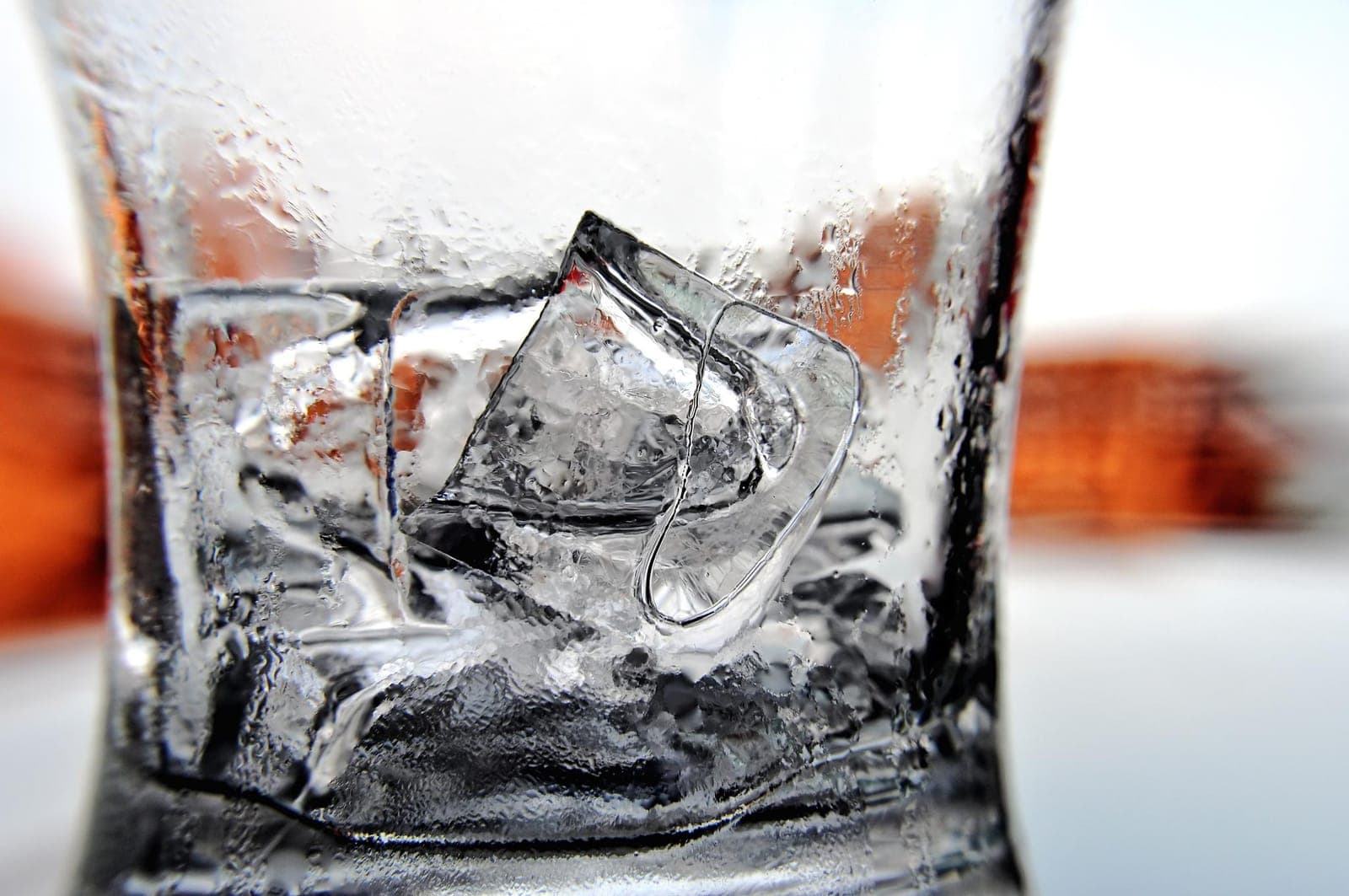
Cloudy ice is not dirty water, it is trapped material. Water pushes dissolved matter out of the crystal as it freezes, so the part that freezes first comes out clear and everything excluded piles up in whatever freezes last. Make the last part somewhere you can throw away and the cube in your hand is clear.
Why freezing sorts things
That sorting is not a bar trick, it is what a growing ice crystal does anywhere, including at sea.
When water freezes, dissolved material is largely excluded from the growing ice crystal and stays behind in the remaining liquid. In sea ice this is documented directly: the forming crystals expel salt, so the ice itself is nearly pure water while the excluded solute concentrates in the water below. By this same exclusion principle, the portion of water that freezes first tends to be purer than the concentrated liquid it leaves behind.1
A home ice tray freezes from every face at once, so all six sides push inward and the excluded material has nowhere to go but the middle. The cloud you see is the pile-up, sitting exactly where the last liquid was.
The whole method in one idea
Read that exclusion rule alongside the tray and the technique follows from it. If heat can only leave through the top surface, the part that freezes first is the top, and whatever the growing crystal excludes has one place left to go, which is downward into the water still unfrozen beneath it.
The bottom then finishes as the cloudy layer, and you cut it off. That is the entire method, and it is why an insulated cooler in the freezer beats any brand of bottled water.
Big clear cubes change the drink too
There is a reason bars want them beyond how they photograph, and it has to do with what a cube does after it lands in the glass.
The rate of heat transfer by conduction into ice is directly proportional to the contact surface area. Crushed ice presents far more surface area than one large cube of the same mass, so it exchanges heat with the drink faster; because the transferred heat is what melts the ice, faster heat exchange means both faster chilling and faster melting. A single large cube, with less surface area, chills and dilutes more slowly.2
A single large cube presents far less surface than the same water in small pieces, so it chills gently and waters the drink slowly. That is the practical payoff: a spirit that stays close to how it was poured for longer.
One thing not to chase
Freezer temperature gets adjusted a lot in pursuit of better ice, and it is mostly wasted effort.
How cold the ice is matters far less than the fact that it melts. Ice taken from a home freezer is below 0 degrees Celsius (32 degrees Fahrenheit), and that below-freezing ice contributes sensible heat as it warms toward 0 degrees Celsius, with the specific heat of ice being about 2090 joules per kilogram per degree Celsius, in addition to the much larger latent heat of 334 kilojoules per kilogram absorbed on melting. Because the melting term dominates, the ice's starting temperature makes only a small correction to a drink's final temperature.3
So a colder freezer does not buy a slower drink. Size and shape are the levers; the thermostat is not.
Make a batch this week
The first attempt usually half works, which is a good sign rather than a bad one. It tells you which face of the container is still letting heat out.
- Put an open container of water inside a small insulated cooler, lid off, and set the whole thing in the freezer.
- Leave it until the top two thirds have frozen and the bottom is still liquid, which usually lands somewhere around 18 to 24 hours.
- Pour off the unfrozen water at the bottom. That is where everything excluded went.
- Let the block sit out for a few minutes so it is not brittle, then cut it into cubes with a serrated knife.
- If the block is cloudy on a side rather than the bottom, that side was losing heat too. Insulate it and run it again.
- If it froze solid all the way through, pull it earlier next time.
- Drop one in a glass of whatever you were going to drink anyway and watch how slowly it goes.
Sources & facts
- 1. Freezing pushes out solutes ↩
- 2. Ice size: surface area sets chill and dilution rate ↩
- 3. Ice temperature vs melting: which chills more ↩
Facts without an external link are drawn from the R&Dish reviewed corpus (textbook-level food science).
TopicBar & Spirits