Why Kombu Dashi Steeps at 60 Degrees Instead of Boiling
Dashi looks like the simplest stock in the world. A strip of dried kelp, some water, and a heat that never quite reaches a boil is the whole of it, and that restraint turns out to be the point. So why hold kombu dashi temperature down near 60 degrees at all?
Why kombu at all
Kelp earns its place in dashi for one reason, and it comes down to raw quantity rather than any trick of technique. Other ingredients bring aroma or body, so what is it that kombu brings?
Kombu kelp is prized in dashi for its high free glutamate content.1
What makes that reputation unusual is that it is not vague at all: where most savory ingredients trade in impressions of depth, kombu can be put on a scale and pinned to a number.
Kombu kelp carries an exceptionally high concentration of free glutamate, on the order of 1,200 to 3,400 milligrams per 100 grams, which is why it serves as the principal glutamate source in dashi.2
The temperature is the technique
With that much glutamate sitting there to extract, the traditional method still did not go for a blast. Boiling was never the tool it chose.
Traditional dashi steeps kombu in water at about 60 degrees Celsius for one hour rather than boiling it, a controlled sub-boiling extraction of its free glutamate. This is one documented extraction protocol, and traditional practice also uses cold overnight soaking and brief steeping just below the boil.3
So the low, slow steep is deliberate rather than timid, and the hour it takes is not idling either. The other half of dashi is what goes in next.
Two of them multiply
Kombu on its own already tastes savory. The moment a second ingredient joins it the broth stops being single-note and starts being the backbone of a cuisine, so what is going in?
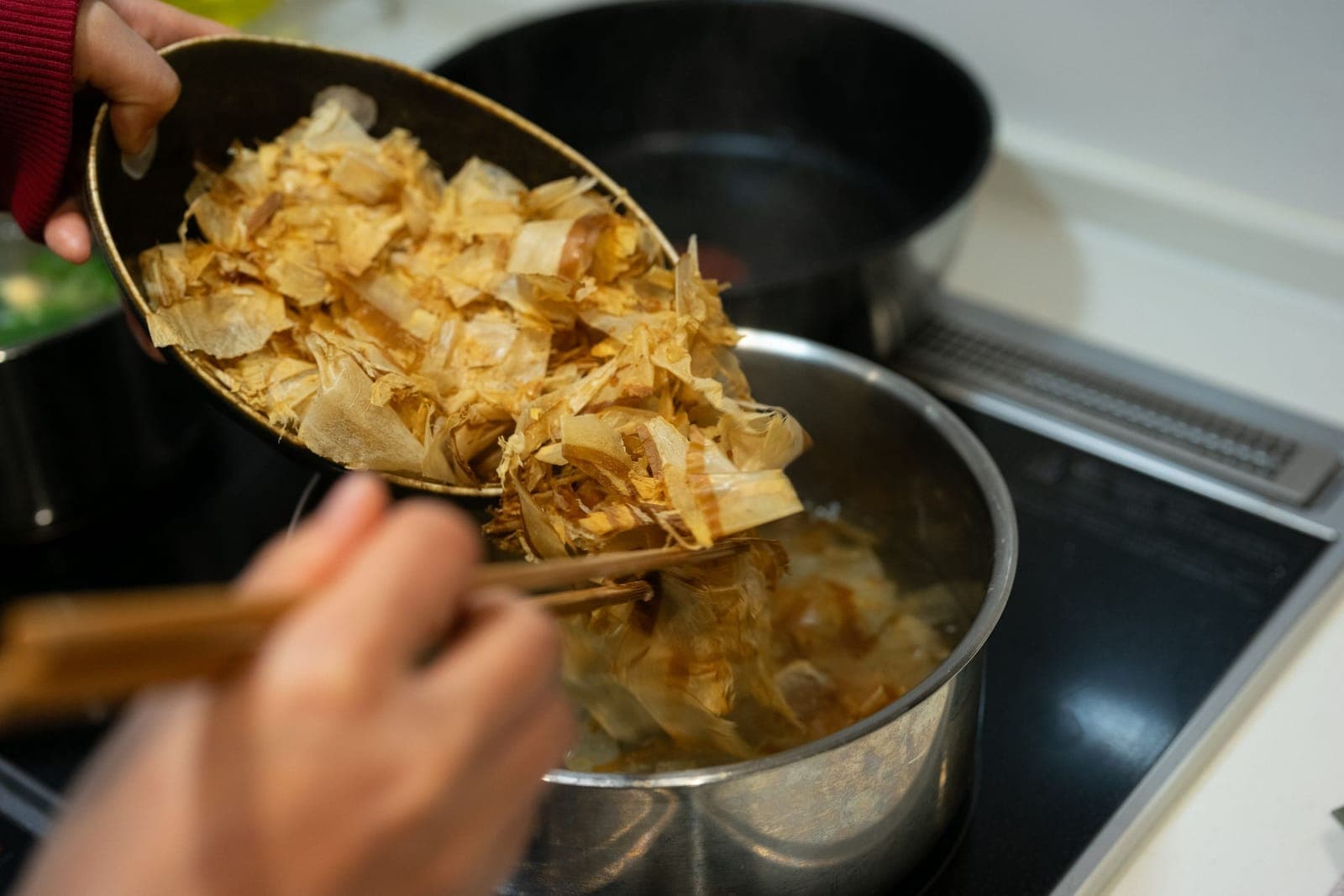
Japanese dashi pairs glutamate-rich kombu with inosinate-rich bonito to create synergistic umami.4
How large that effect gets is worth stating precisely. It does not hold the same across species.
In humans the umami intensity of a glutamate solution is about 8 times larger when inosinate is added, whereas in rats the neural response is about 1.7 times larger, and this multiplicative synergy is the basis of dashi, which pairs glutamate-rich kombu with inosinate-rich katsuobushi. The 8 times and 1.7 times figures are measured at particular glutamate and inosinate concentrations, and the size of the synergy moves with the ratio of the two.5
- Steep kombu in water held near 60 degrees Celsius for about an hour rather than boiling it, drawing the glutamate out gently.
- Keep the kombu below a boil, since the traditional method is a controlled sub-boiling steep, not a rolling one.
- Pair the kombu with an inosinate source such as katsuobushi, so the amino acid and the nucleotide multiply rather than merely add.
- Expect the paired dashi to taste far more savory than either part alone, the practical face of the synergy the numbers describe.
- Reach for kombu when you want a glutamate base to build on, then let a second ingredient supply the inosinate that unlocks the multiplier. A single spoonful of the result fills the whole mouth.
Sources & facts
- 1. Kombu: glutamate for dashi ↩
- 2. Kombu glutamate: how much umami kelp holds ↩
- 3. Kombu dashi: steeping at about 60 degrees ↩
- 4. Dashi: umami synergy in a bowl ↩
- 5. Umami synergy: why dashi tastes far savorier ↩
Facts without an external link are drawn from the R&Dish reviewed corpus (textbook-level food science).
TopicFermentation & Umami