Soft Boiled Egg Time: Why the Clock Is Not What Sets Your Yolk
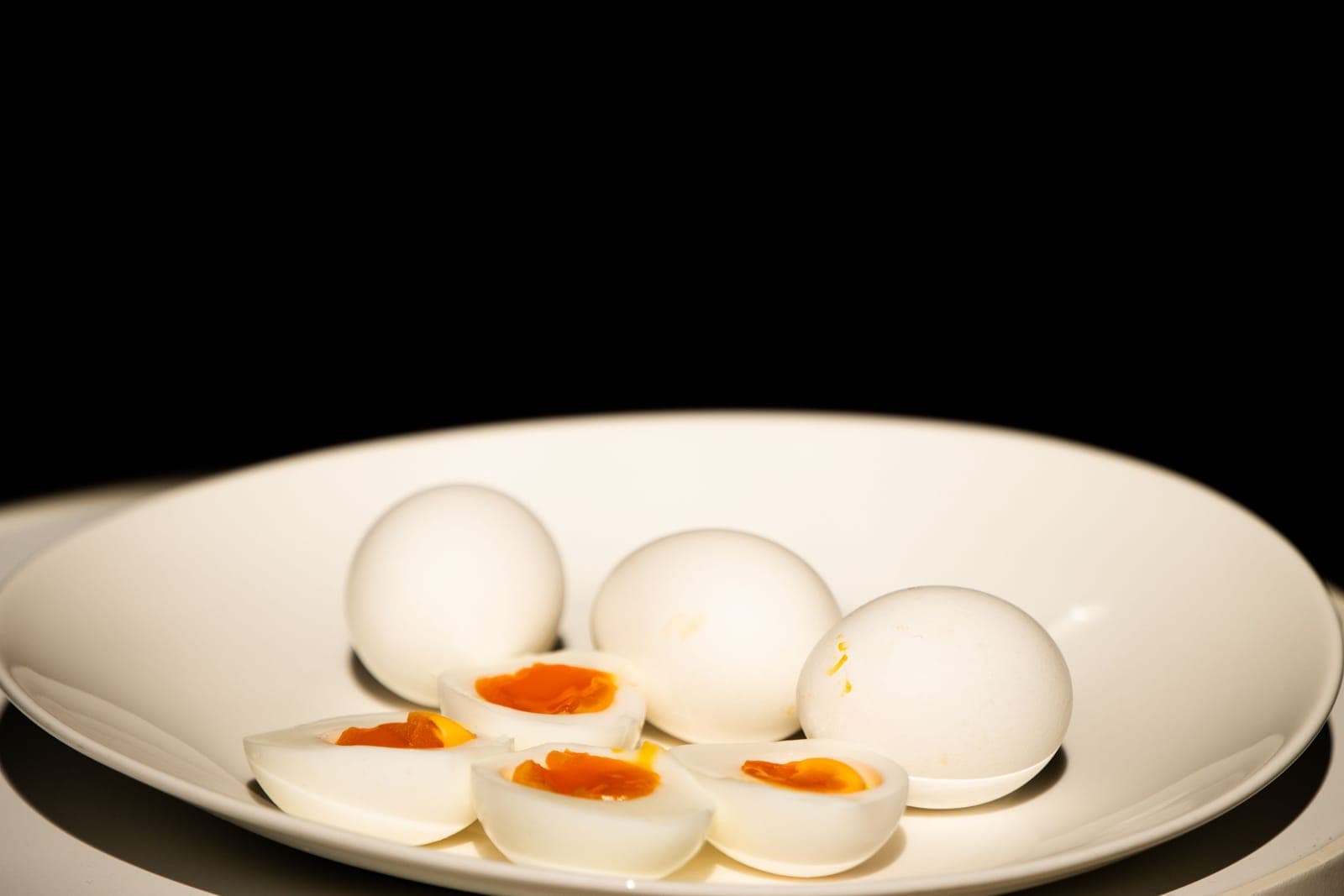
Two eggs go into the same pot for the same four minutes and come out different: one yolk barely holding its shape, one already chalky at the edge. You pressed the same stopwatch for both. So why do they split?
Two proteins, two thresholds
An egg is not one uniform substance cooking at one uniform rate. It is two separate protein systems, layered inside the same shell, each with its own trigger point. Neither one cares what the clock on the wall says; both respond only to how hot the egg has actually gotten inside. So what does heat actually do to a protein?
Heat denatures proteins by unfolding their structure, after which they bond into a firm network.1
Heat is what pulls those tangled proteins open in the first place, and once they unfold they start finding new bonds to each other. The place that happens first is the outer layer, the white.
Egg white proteins begin to coagulate around 62 degrees Celsius.2
Which means the white is already solid while plenty of yolks are still loose. That gap is the whole reason a soft-boiled egg is possible, so where does the yolk's own number fall?
Egg yolk thickens and sets between about 65 and 70 degrees Celsius.3
That five-degree window is narrower than it sounds. A minute of extra time, or water that never quite returned to a boil after the egg went in, is enough to push the yolk from jammy to firm.
Find the time that fits your pot
Timing is a proxy for temperature, not the thing itself. So the way to dial in your own soft-boiled egg is to test a range and take notes, rather than chase someone else's stopwatch number. Write it down once, properly, and you never have to guess in that pot again.
- Bring a pot of water to a full boil before lowering the eggs in, so every egg starts from the same temperature.
- Cook eggs in a batch at staggered times, for example 6, 7, and 8 minutes. Boil a few more than you need and write off the misses; it takes the pressure off.
- Transfer each egg to an ice bath immediately when its time is up, to stop the yolk from continuing to set from residual heat.
- Peel and halve each egg to check the yolk's texture at its center, not just at the edge.
- Note which time gives the texture you want, from barely set to fully jammy.
- Repeat the test with a different starting egg temperature, such as straight from the fridge versus room temperature, since a colder egg needs more time to reach the same internal temperature.
- Use the same size of egg for every test, since a larger egg takes longer to reach the same internal temperature than a smaller one.
- Record your chosen time as your baseline for that pot, burner, and egg size going forward. After that it is one number and breakfast.
Sources & facts
Facts without an external link are drawn from the R&Dish reviewed corpus (textbook-level food science).
TopicEveryday Science