Herb Aroma Compounds: A Cook's Map of Terpenes and When to Add
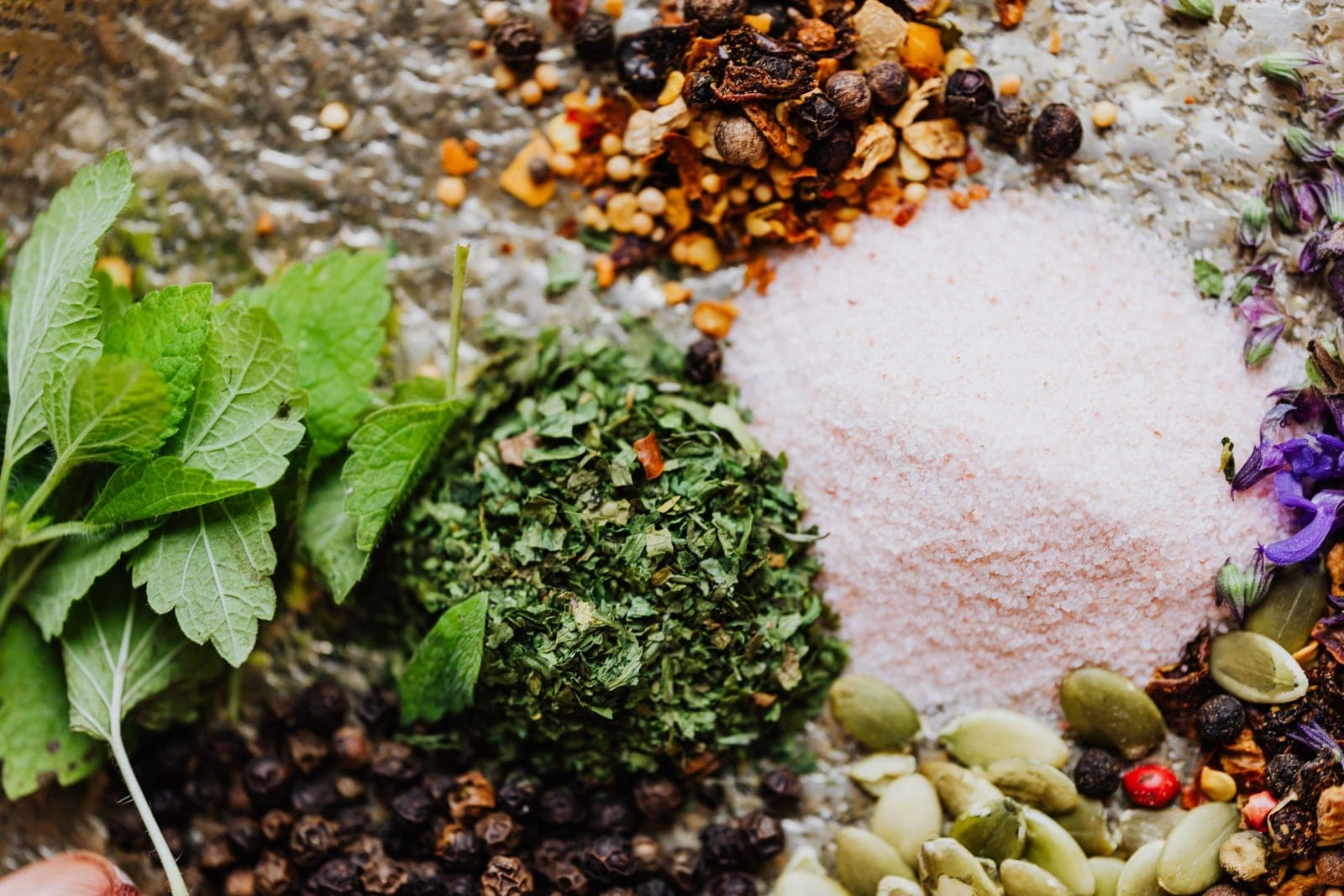
Tear a basil leaf with your fingers and the smell arrives before you have done anything with it, and a lemongrass stalk or a strip of orange peel each announce themselves a different way. They are all just green leaves, so why do they smell nothing alike? Learn the herb aroma compounds behind a handful of common ingredients and you stop guessing about when to add them or what will sit well beside what.
One family behind much of it
Most of these scents turn out to be relatives.
Many herb aromas come from terpene compounds, which are volatile and easily lost to heat.1
Volatile and easily lost to heat: hold onto that phrase, because it decides technique later on. Terpenes are what let a bunch of herbs perfume an entire kitchen from the cutting board, and they are equally what makes that perfume thin out the second the leaves hit a simmering pot. Within one family, though, each herb leads with its own note.
A short map of signatures
Start with sweet basil, the one dropped onto a margherita pizza, which leads with a soft, floral character.
Sweet basil's aroma is dominated by linalool and eugenol.2
The two share a name, and yet swapping in Thai basil tips the whole profile somewhere else entirely.
Thai basil has an anise-like aroma from estragole, distinguishing it from sweet basil.3
Walk past the herb garden to a lemongrass stalk and the scent turns bright and citrusy, carried by a different compound altogether.
Lemongrass aroma is dominated by citral, a mix of the aldehydes geranial and neral.4
That same lemon brightness has a cousin in citrus peel. Another terpene carries it.
The fresh aroma of citrus peel is dominated by limonene, concentrated in the zest oils.5
Why timing follows from chemistry
The compounds on this map smell nothing alike, but every one of them shares a single property, volatility, and that one property decides when each of them belongs in the pot.
Delicate herb aromatics are best added late in cooking because heat drives off their volatile compounds.6
So the map doubles as a schedule. The more delicate the aromatic, the further back it moves, because heat spends those volatile compounds fast, and read from this angle the chemistry stops being trivia: it is the difference between a sauce that tastes of fresh herbs and one that tastes of the memory of them.
Cook by the aroma map
Once you know the compound, how to treat the ingredient follows on its own, so put the map to work in your own kitchen.
- Add delicate fresh herbs like basil at the very end or off the heat, so their volatile aromatics are not driven off before serving.
- Reach for sweet basil when you want its soft, floral linalool-and-eugenol character, as in a Caprese or a pesto stirred in cold.
- Choose Thai basil, not sweet basil, when a dish wants that anise-like estragole note; the two are not interchangeable.
- Bruise or bend lemongrass before it goes in to release more of its citral, and add it early enough to infuse but pull the tough stalks before serving; if you forget, they are easy enough to fish out at the table.
- Zest citrus straight over the finished dish to capture the limonene in the peel oils, which fades quickly once grated, and take a spoonful to your nose right then to catch it at full strength.
Sources & facts
- 1. Terpenes carry herb aroma ↩
- 2. Sweet basil: linalool and eugenol ↩
- 3. Thai basil's anise note ↩
- 4. Lemongrass: citral's lemon lift ↩
- 5. Citrus zest: limonene ↩
- 6. Add fragile herbs late ↩
Facts without an external link are drawn from the R&Dish reviewed corpus (textbook-level food science).
TopicPairing & Flavor