Soy Sauce Butter: Testing the Umami Upgrade
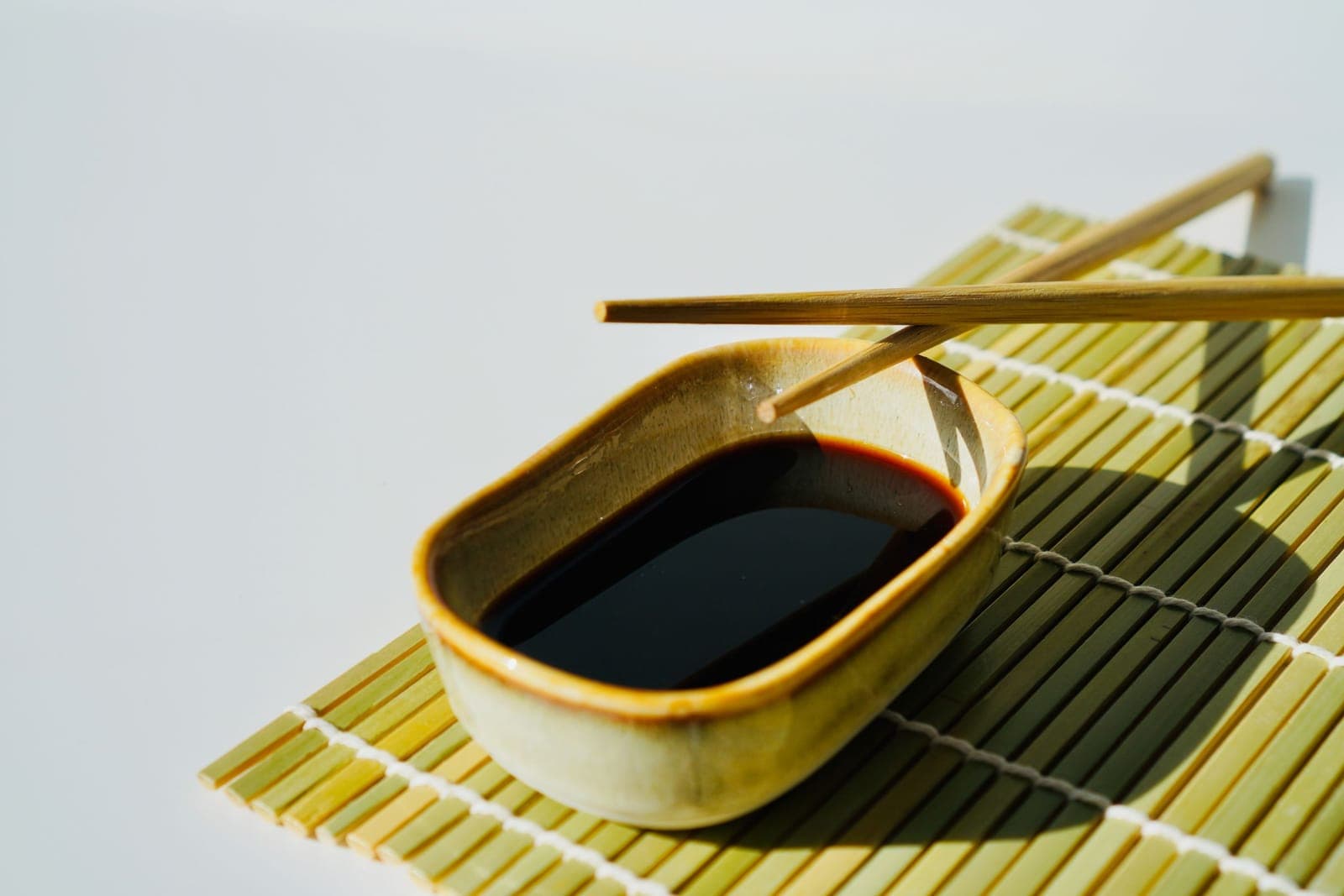
Plain butter melted over hot rice or steamed greens is already close to perfect, and then you whisk in a teaspoon of light soy sauce and the whole spoonful tips: savory, glossy, satisfying out of all proportion to the effort it took. Japanese cooks have leaned on this shoyu-butter move for years. So how does one teaspoon move the flavor that far?
Where the umami comes from
The savory jolt starts with the soy sauce. More precisely it starts with how the soy sauce is made, because this is not salty water but a liquid that has come out the far end of a long fermentation.
Soy sauce develops flavor over months of fermentation in which koji enzymes and salt-tolerant microbes break down soybean and wheat proteins.1
Breaking those proteins down releases a flood of free amino acids, and exactly one of them holds the key to savoriness.
Free glutamate is the primary source of umami, the savory basic taste.2
So a teaspoon of soy sauce is really a concentrated dose of glutamate, which accounts for the savory hit all on its own. It still does not account for why the flavor reaches every corner of your mouth and stays there. The answer is in what you dissolve it into.
Why butter is the right vehicle
Butter is not a neutral carrier that merely ferries flavor along; fat does a specific job in the mouth that neither water nor salt can manage.
Fat dissolves and carries fat-soluble aroma compounds, spreading flavor across the palate.3
That carrying power is why soy-butter coats the tongue and holds on well after the bite instead of washing straight off. Butter happens to be built for the job.
Butter is roughly 80 percent milk fat, with the remainder mostly water and milk solids.4
All that fat gives the aroma compounds somewhere to dissolve, while the small amount of water lets the soy sauce blend in smoothly, and the salt riding along in the soy sauce adds a layer of its own on top.
Salt suppresses the perception of bitterness and enhances other flavors.5
So the salt lifts the surrounding flavors while the fat spreads the umami across the palate, and the two effects stack inside a single spoonful. There is really only one way to spoil it, and it happens before the sauce ever reaches the plate.
Test it in your own kitchen
Before you taste anything, one thing deserves respect: butter is an emulsion, and heat is its enemy.
A butter emulsion breaks when overheated, as the milk fat coalesces and separates from the water phase.6
That is why the steps below keep the butter over low heat, since a broken, greasy sauce carries flavor far worse than a smooth one. The rest is simple. Taste butter alone against butter plus soy, change nothing else, and let your palate call it.
- Prepare two identical portions of a neutral base, such as plain steamed rice or blanched green vegetables, so the base does not compete with the butter.
- Melt 30 g of butter over low heat for each portion, keeping the temperature gentle so the emulsion stays intact; if it starts to split, pull it off the heat and whisk, and it usually comes back.
- Season portion A with the melted butter only, as your control.
- Whisk 1 teaspoon of light soy sauce into the melted butter for portion B until it emulsifies smoothly.
- Taste both portions side by side and rate umami depth, salt balance, and aroma persistence.
- Adjust the soy sauce in half-teaspoon steps across repeats and record the preferred ratio, since the ideal dose shifts with the saltiness of your soy sauce, and one mouthful of rice stirred at that ratio settles which version is yours.
Sources & facts
- 1. Soy sauce: months of enzymatic breakdown ↩
- 2. Glutamate is umami · Pottier et al., *Ribonucleotides differentially modulate oral glutamate detection thresholds* · Molecular mechanism for the umami taste synergism ↩
- 3. Fat as a flavor carrier ↩
- 4. Butter: an 80 percent fat emulsion ↩
- 5. Salt tames bitterness ↩
- 6. Butter emulsions: holding the sauce together under heat ↩
Facts without an external link are drawn from the R&Dish reviewed corpus (textbook-level food science).
TopicPairing & Flavor