Sugar Stages Explained: Soft Ball to Hard Crack, and Why They Matter
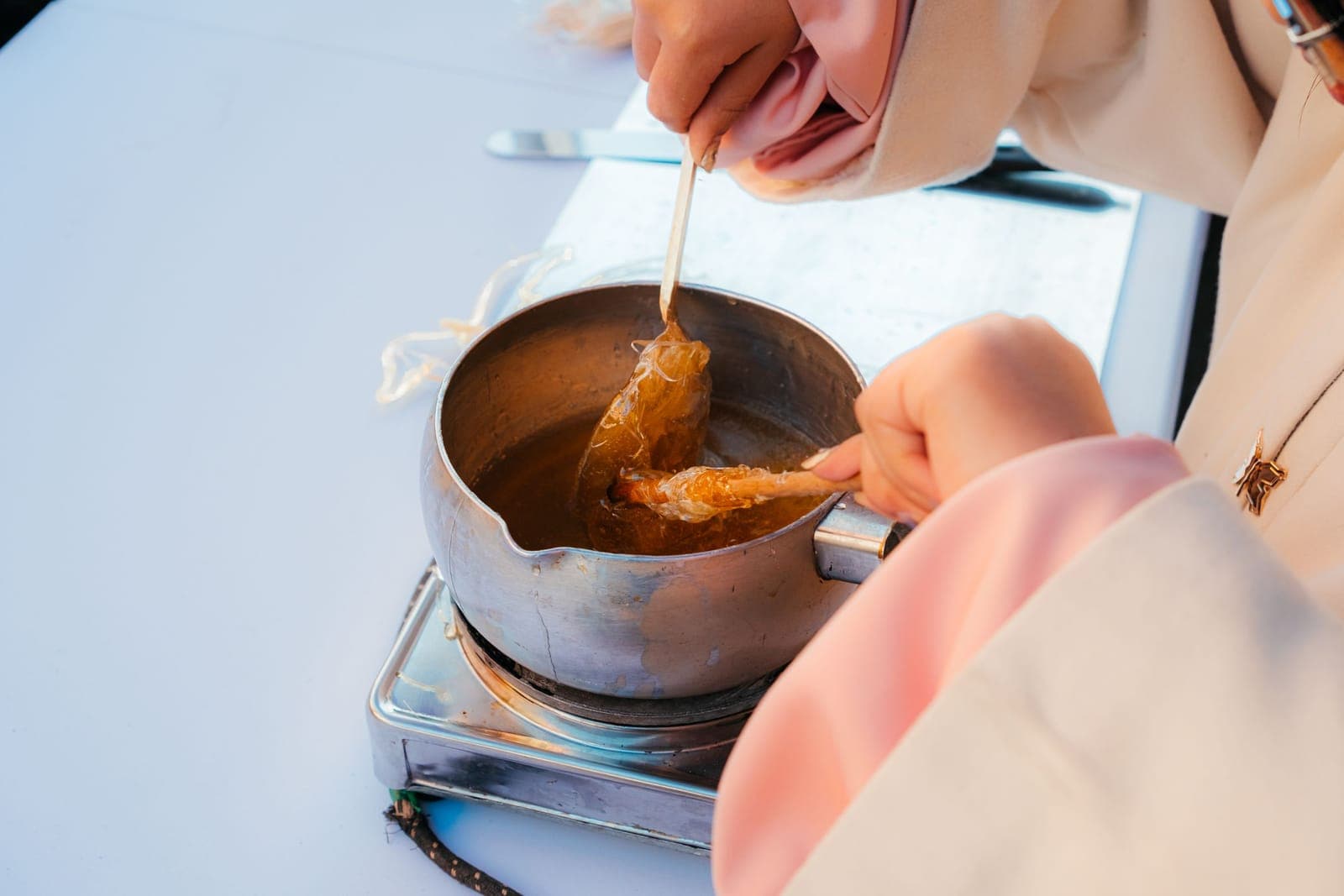
Old candy recipes talk in a language of their own: soft ball, firm ball, hard crack. Before candy thermometers were common, you tested by dropping a bit of hot syrup into cold water and reading what the blob did between your fingers. So what are those names actually counting? Not folklore, and not guesswork either. Each one marks how much water has boiled away, and what the cooled candy will feel like in your mouth.
The stages are water leaving
A sugar syrup gets hotter as it boils, but the heat is not the point; it is what is left once the water goes. What stays behind is more and more sugar, which is why one number on a thermometer can tell you about texture. So where does that number travel?
Boiling sugar syrup passes through defined stages such as soft ball and hard crack, set by rising temperature and concentration.1
Up to that point the sugar has only been getting denser. Push past hard crack and it stops merely concentrating, browning into something else. That browning has a starting line, and it is a fairly specific one.
Table sugar begins to caramelize around 160 to 170 degrees Celsius.2
The trouble is how narrow that window is. Leave it a moment longer because it smells so good, and caramel stops paying you back in sweetness.
Prolonged caramelization develops bitter notes as sugars break into darker, more complex compounds.3
When it seizes up out of nowhere
The thermometer is not the only thing worth watching. A syrup that was clear a moment ago can turn cloudy and stiff, wrecking the pot before you reach your target. Why does that happen?
A supersaturated sugar syrup holds more dissolved sugar than is stable at that temperature and crystallizes readily.4
Think of the syrup as carrying more sugar than it comfortably can. Balanced that precariously, it does not need much of a push to tip over.
Stray crystals or agitation can seed unwanted crystallization in candy syrups.5
So what ruins a glassy candy is rarely a big mistake. It is one dried crystal on the side of the pot, or the single stir you could not resist. Turn that around: keep the syrup clean and leave it alone, and the stages arrive on schedule.
Work the sugar stages at home
A thermometer takes the guesswork out from the first minute. The rest is protecting the syrup on its way up to your target.
- Clip on a candy thermometer and read the stages instead of guessing; they are temperature marks, not colors. Missing your window the first few times is fine.
- Aim for the soft ball range near 112 to 116C for fudge and fondant, and the hard crack range near 146 to 154C for brittle and lollipops.
- Brush stray crystals down the sides of the pot with a wet pastry brush as it cooks, since one of them is the seed that sets off the rest.
- Resist stirring once it boils, since that one stir is the trigger.
- A spoonful of corn syrup or a squeeze of lemon helps keep the syrup smooth. Think of it as cheap insurance.
- Stay by the pot near the caramel window; it slides from amber to bitter fast.
- Stop the cooking at your target by pulling the pot off the heat and dipping its base in cold water. Whatever temperature you stopped at is the texture you will bite into.
Sources & facts
- 1. Sugar stages: soft ball to hard crack ↩
- 2. Sugar caramelizes near 160C ↩
- 3. Deep caramel turns bitter ↩
- 4. Supersaturation, defined ↩
- 5. How candy syrups seize up ↩
Facts without an external link are drawn from the R&Dish reviewed corpus (textbook-level food science).
TopicSugar & Baking