Why Do Tomato and Parmesan Always Turn Up Together?
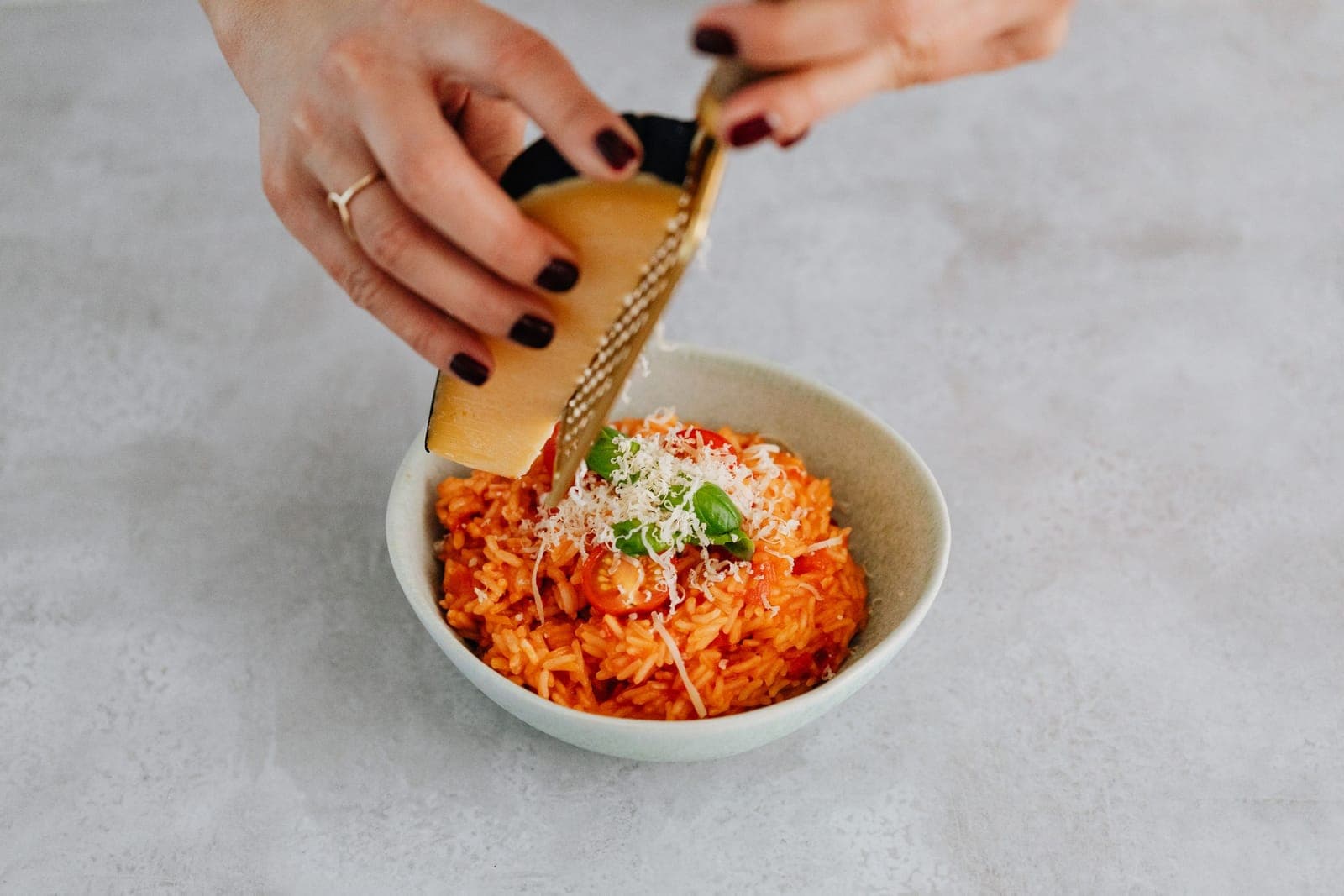
Tomato and parmesan show up together so often that we stop noticing it: on pizza, in a bowl of pasta, over a caprese salad, melted into a plate of eggplant. The pairing feels like plain common sense. So why these two?
Where the savory weight comes from
Savory depth is not a vague quality; it has a name and, largely, a single molecule behind it.
Free glutamate is the primary source of umami, the savory basic taste.3
So the more free glutamate an ingredient carries, the more savory it tastes. Bite into a ripe tomato and past the sweet and the sour there is something weightier sitting there, which is odd for a fruit.
Ripe tomatoes are a significant plant source of free glutamate.1
That savory weight is why a tomato behaves less like a fruit and more like a seasoning. Now put it next to the ingredient at the far end of the same scale, which this time is not a fruit but a cheese.
Parmigiano-Reggiano is among the cheeses highest in free glutamate.2
Years of aging break the cheese's proteins down into free glutamate, so a shower of grated parmesan lays down concentrated umami. Put the two on one plate and you are stacking two of the biggest glutamate sources in the kitchen. That alone would explain the appeal, and it is still not the whole story.
More than the sum of two savories
If tomato and parmesan only added their glutamate together, the result would be savory but predictable. Is addition all that is going on?
Glutamate combined with the nucleotide inosinate produces a synergistic umami far stronger than either one alone.4
Glutamate and inosinate together taste far stronger than the sum of their parts, and inosinate is abundant in meat, cured ham, and fish. That is why a little prosciutto or anchovy over tomato and parmesan sends the savoriness through the roof: it brings the second half of the synergy. Tomato and parmesan lay down the glutamate base, and an inosinate-rich ingredient is what multiplies it.
Test it in your own kitchen
The test below isolates what the cheese actually adds, then lets you feel the synergy for yourself. Roasting matters here, since gentle heat concentrates the tomato's glutamate as moisture cooks off and the savory contrast gets easier to read.
- Slice ripe tomatoes and arrange the slices on a baking tray in a single layer so they roast rather than steam.
- Grate Parmigiano-Reggiano over half of the slices and leave the other half plain as a control, so the cheese is the only variable.
- Roast the tray in a 200°C oven, hot enough to drive off water and concentrate the tomato's savory glutamate.
- Remove the tray once the cheese turns golden and the tomatoes have softened. Your eyes are better at this than a timer.
- Taste the plain and parmesan-topped slices side by side.
- Record the perceived savoriness of each portion. An impression is enough; it does not have to be a number.
- Repeat the test with an inosinate-rich ingredient such as cured ham or dried mushroom added to a portion, to feel the glutamate-inosinate synergy directly.
- Vary the cheese-to-tomato ratio across batches and record where the balance tastes best. Whichever one wins goes straight onto the next bowl of pasta.
Sources & facts
- 1. Tomatoes: a glutamate source ↩
- 2. Parmigiano-Reggiano: a glutamate-forward pairing anchor ↩
- 3. Glutamate is umami · Pottier et al., *Ribonucleotides differentially modulate oral glutamate detection thresholds* · Molecular mechanism for the umami taste synergism ↩
- 4. Umami synergy: glutamate plus inosinate · Pottier et al., *Ribonucleotides differentially modulate oral glutamate detection thresholds* · Molecular mechanism for the umami taste synergism ↩
Facts without an external link are drawn from the R&Dish reviewed corpus (textbook-level food science).
TopicPairing & Flavor