When Does Meat Lose Its Juice? A Temperature Ladder
when does meat lose its juice while cooking
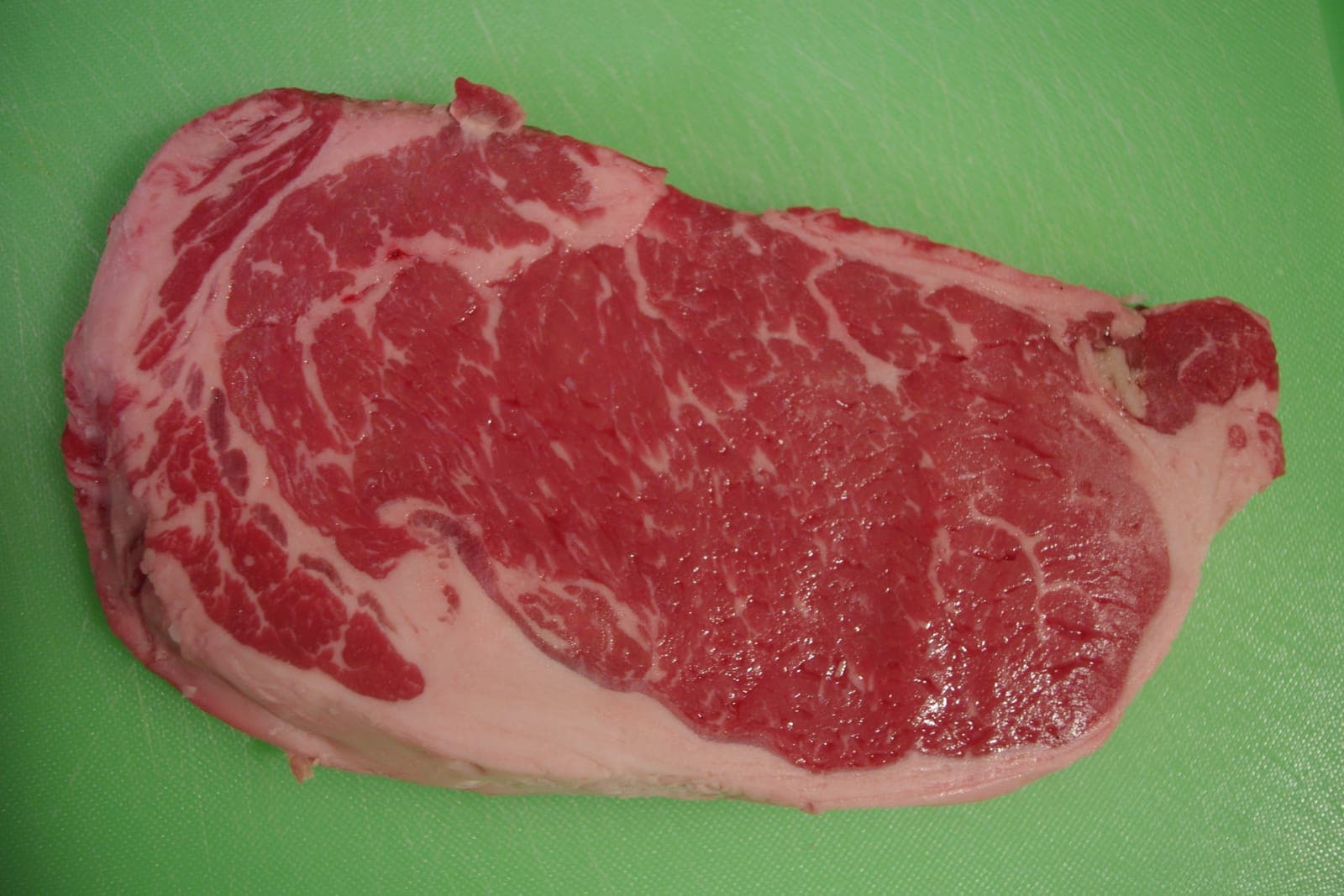
Juice leaves meat in stages, not all at once, and each stage is tied to a temperature rather than to a minute on a timer. Push past roughly 64 degrees Celsius and the connective tissue starts wringing the meat out, which is the single biggest step on the ladder.
Searing gets blamed for this constantly, so it is worth closing that question before climbing the ladder itself.
Searing meat develops flavor through browning but does not seal in juices.1
That crust is doing real work on flavor, just not the work of holding anything in. Whatever leaves the meat leaves because of what the heat does inside it, so the useful question is when.
The first rung: the fibers tighten
Long before a steak looks cooked through, the muscle has already been busy. One study measured how much the fibers pull in sideways as the temperature climbs, and most of that movement was finished surprisingly early.
The same study measured shrinkage in two directions and reports that most of the transverse shrinkage, 18 to 22 percent, had already occurred by the time the cuboids reached 50 degrees Celsius, in all three muscles. Biceps femoris and semitendinosus shrank further across the fibres at 70 degrees Celsius than at 50 degrees Celsius and then stopped, with no further increase at 80 degrees Celsius. Psoas major reversed after 60 degrees Celsius: its transverse shrinkage rose from 50 to 60 degrees Celsius and then fell again at 70 and 80 degrees Celsius, leaving it the least shrunken across the fibres of the three at the top of the range.2
Fifty degrees is rare steak. So by the time a steak reads medium rare, the fibers have already done most of their sideways pulling, and it is still juicy on the plate. Something else must run the loss further up.
The big rung: collagen wrings it out
That something is the connective tissue wrapped around and between the fibers, and it has a temperature of its own.
Muscle collagen shrinks and squeezes out juices around 60 to 65 degrees Celsius before it slowly gelatinizes.3
This is the rung where the arithmetic changes, and a study that mapped cooking loss across a range put a number on where the curve turns.
Raising the cooking temperature from 52.5 to 60 degrees Celsius causes an increasingly rapid loss of fluid from the myofibers but still without overall shortening, whereas cooking at 64 to 94 degrees Celsius increases cooking loss through the heat shrinkage of the endomysial, perimysial, and epimysial collagen, and with a long period of cooking partial or complete gelatinization of collagen leaves the meat soft and tender.4
Below that band you are losing fluid gradually. Above it, the wrapping itself contracts and squeezes, which is why a steak taken to well done reads dry in a way a medium one never does. Hold it there long enough and the same collagen softens into gelatin, which is exactly what a braise is built on.
The rung nobody mentions: aging
There is one more variable that arrives before the pan does, and it moves juice in a direction most people do not expect.
In that same study of semitendinosus, biceps femoris and psoas major, ageing for 14 days at 2 degrees Celsius reduced shear force in every muscle, and it also raised cooking loss by 3 percent compared with the same muscles cooked at 1 day post mortem. The 3 percent penalty held across all three muscles and all four cooking temperatures the study used. Ageing is normally described as a tenderising step, and in that experiment it was one, but the yield moved the other way at the same time.5
So an aged steak is easier to chew and gives up a little more on the way there. That is a trade rather than a flaw, and knowing it is a trade is what keeps you from blaming the pan.
Climb the ladder yourself
The whole ladder is legible with a probe thermometer and a kitchen scale, and the measured version is far more convincing than a guess. Weighing is the part that turns an impression into a number you can compare cook to cook.
- Cut one steak into three pieces of roughly equal thickness so the cut and the animal are held constant.
- Weigh each piece raw and write the numbers down before anything goes near heat.
- Cook the pieces to 50, 60, and 70 degrees Celsius internal, using a probe rather than time.
- Rest all three the same length of time, then weigh each one again.
- Work out the loss as a percentage of the raw weight for each piece.
- Compare the step from 50 to 60 against the step from 60 to 70. The second gap should be the wider one.
- If the numbers come out messy, that is normal for a first run. Thickness and probe placement move them more than anything else, so repeat with thicker pieces before drawing conclusions.
- Then eat all three side by side, because the texture difference lands harder than the arithmetic does.
Sources & facts
- 1. Searing flavors, but doesn't seal ↩
- 2. Most of the crosswise shrink happens by 50 degrees ↩
- 3. Collagen shrinks near 60C ↩
- 4. The cost of pushing past 64 degrees ↩
- 5. Ageing tenderised and cost 3 percent in yield ↩
Facts without an external link are drawn from the R&Dish reviewed corpus (textbook-level food science).
TopicMeat & Heat